

Imagine walking into your living room, asking the air to dim the lights, adjust the thermostat, and start your coffee maker—all at once. In 2026, that sounds like the default expectation for an "AI home." Yet, if you’ve wandered the halls of IFA 2026 or scrolled through the press releases, you’ve likely hit a frustrating wall of buzzwords. We are promised seamless "companions" and autonomous agents, but when it comes to actually plugging these systems into your daily life, the reality is far more fragmented. Are LG’s open-source AI hubs the future, or is Samsung’s practical, hardware-first approach the real winner?
LG’s ThinQ Claw represents a bold leap into open architecture. Rather than locking you into a proprietary walled garden, LG built its next-generation AI home agent on OpenClaw, a rapidly growing open-source framework. This means the hub can independently trigger automations and control a vast array of devices, from lighting to appliances. By acquiring Athom (the maker of Homey) and integrating it as the interoperability layer, LG supports Matter, Thread, Zigbee, and Z-Wave out of the box.
If you are a tech enthusiast who loves tweaking, local processing, and keeping your data on-premise, LG’s vision is undeniably exciting.
However, ambition comes with a caveat. Because OpenClaw connects language models to real-world tools and APIs, the potential for security and privacy risks is higher. While the automations run locally, LG has yet to clarify exactly where the conversational context of the AI agent is stored long-term or how it handles multi-user data sharing.
Samsung, on the other hand, isn’t trying to build a single "brain." Instead, they’re renting the brains. Samsung’s IFA 2026 strategy focuses on embedding top-tier AI models—Gemini, Perplexity, and Microsoft Copilot—directly into the devices you already own. Their TVs and refrigerators act as the interface, leveraging the hidden Thread border routers that have been quietly built into Samsung hardware since 2022.
The brilliance of Samsung’s approach is its accessibility. You don’t need to buy a mysterious, unpriced prototype hub. You just need a Samsung TV or a Family Hub fridge.
This method may lack the sci-fi allure of a humanoid robot folding your laundry, but it works today. Samsung’s recent integration of IKEA Matter-over-Thread devices allows you to start with a $5.99 smart bulb and instantly expand your network, proving that incremental, practical upgrades often beat grand, unshipped promises.
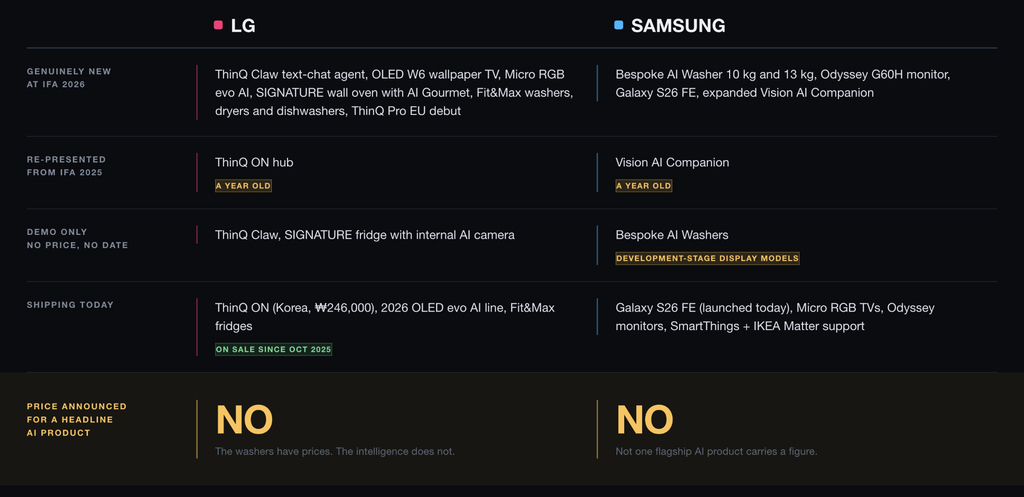
Here is the hard truth that no press release will tell you: neither LG nor Samsung has officially put their flagship AI agents up for sale. The ThinQ ON device, which debuted last year, is available in Korea for about $172, but the advanced "Claw" agent remains a demonstration. Similarly, Samsung’s Bespoke AI washers and Vision AI Companion features are still largely in development or re-staged from last year.
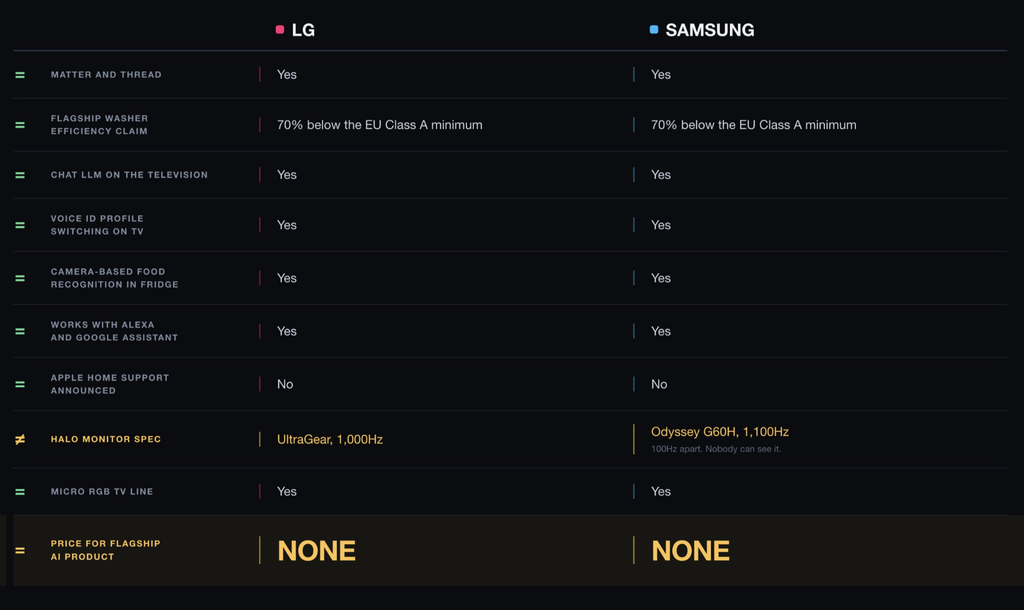
While both companies showcase impressive 1,000Hz monitors and humanoid robots conducting laundry orchestras, these are marketing spectacles. If you are shopping for a smart home setup right now, the real value isn't in the vaporware—it's in what you can actually unbox, install, and use.
Beyond the hardware, there is a crucial question both giants are dodging: "What does the AI remember, and for how long?" LG claims its agent learns your schedule and preferences, but their security documentation lacks a clear data retention policy for chat contexts. Samsung’s cameras capture internal fridge data and send it to external AI providers for processing, yet their privacy notices don't specify if these images are stored temporarily or permanently.
For a smart home to truly be your home, you need transparency about data stewardship. Until then, the focus should be on systems that offer you the most control over your digital footprint.
So, where does that leave you as a buyer? It comes down to your tech comfort level.
- For the Samsung Household: If you already own a Samsung TV (2022 or newer), you have a built-in smart home router. Start small by adding affordable Matter-over-Thread sensors or smart plugs. Automate simple routines, like hallway lights turning on at sunset, to test the ecosystem before investing in major appliances.
- For the DIY Enthusiast: If you crave deep customization and local control, LG’s ecosystem paired with Home Assistant is the superior long-term bet. It allows you to manage devices from various brands in one local dashboard. Just remember to buy LG for the high-quality hardware, not for the unreleased ThinQ Claw AI features.
The IFA 2026 smart home war isn't about flashy robots or unshipped prototypes—it’s about which system delivers reliable, secure automation to your doorstep today. While LG offers a tantalizing glimpse into an open, autonomous future, Samsung’s pragmatic approach of integrating proven AI into existing hardware makes it the more accessible choice for the average user. Choose the ecosystem that matches what you can actually buy, install, and control. Your smart home shouldn't be a science experiment; it should just work.